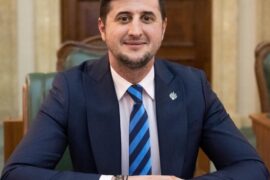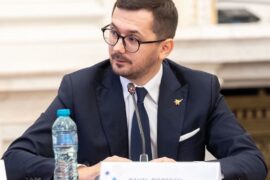
I was honored to speak at the inaugural research symposium organized by American University School of International Service and Young Professionals in Foreign Policy (YPFP) – D.C. Branch, “Reimagining Foreign Policy in a Transforming World.”
Our panel, moderated by Imran Bayoumi, Associate Director of the Atlantic Council’s GeoStrategy Initiative, focused on security architecture in the age of geopolitical disruption. I joined a distinguished panel examining Black Sea security four years into Russia’s full-scale war in Ukraine.
I presented research reconceptualizing “NATO’s eastern flank” not as a unified strategic front as it is often implied in Washington’s policy circles, but as two asymmetric security communities – one cohesive, one dangerously fragmented. Using Karl Deutsch’s framework, I argue that while Poland and the Baltic states have forged a genuine regional security community rooted in shared existential threat perceptions, the Black Sea NATO allies cannot claim the same, as Turkey’s pursuit of strategic autonomy and its “Blue Homeland” doctrine fundamentally diverge from the Euro-Atlantic alignment sought by Bucharest and Sofia.
As the Alliance rallies around the northern flank, the Black Sea risks becoming NATO’s strategic blind spot – and with Russia’s militarization reshaping the region’s balance of power, that is a vulnerability the West can no longer afford to ignore.
To that end, I concluded with two policy recommendations: integrating Turkey into the emerging EU Black Sea Maritime Security Hub as an associate member, and expanding the Three Seas Initiative as an alternative cooperation framework – both designed to work with, rather than against, Ankara’s regional ambitions while creating avenues for win-win economic cooperation.
Many thanks to the Office of Research School of International Service for hosting us, and to our audience and fellow researchers. Savannah Taylor Ido Leidner Marialaura De Angelis Office of Research School of International Service (SIS)

Related Posts