The first day of the NATO Industry Forum 2025 in Bucharest closed with a resounding message that echoed throughout the halls of the Palace of Parliament and the surrounding conference venues: “No spending more, spending smarter.” It was not just a slogan or a call for fiscal prudence – it was a strategic imperative defining the Alliance’s posture for the decade ahead.
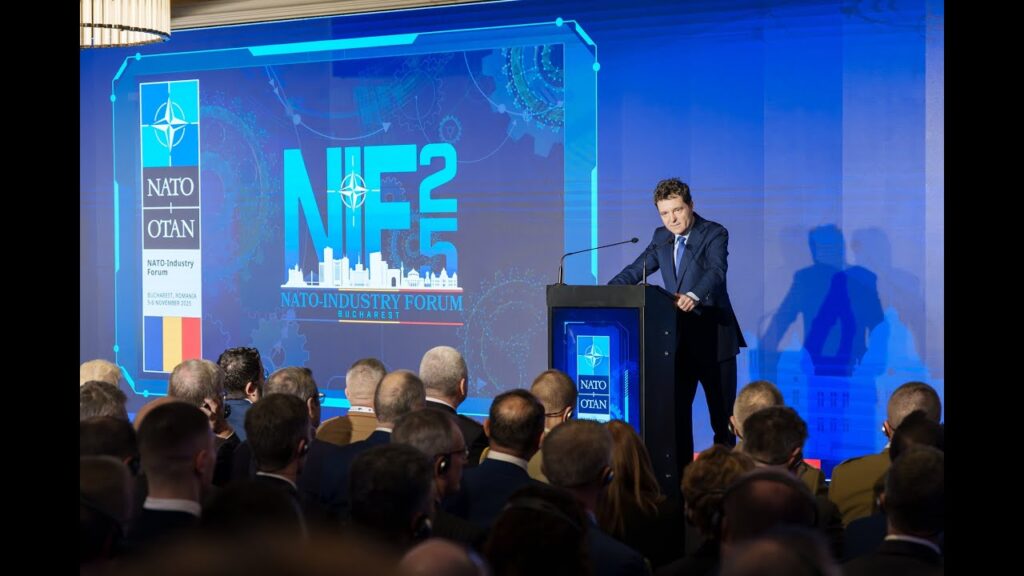
This statement captured the essence of a world where defence and deterrence depend not solely on budgets, but on innovation, coordination, and the intelligent use of industrial capability. The discussions, speeches, and bilateral meetings that unfolded throughout November 5 set the tone for a new era of defence collaboration in which efficiency, adaptability, and partnership stand at the forefront.
A Day Charged with Anticipation
From the early morning hours, the atmosphere in Bucharest carried a sense of purpose. The city—known for its layered history at the crossroads of East and West – was, for two days, the symbolic and logistical centre of the transatlantic defence conversation. Delegates from across NATO member states arrived: civilian officials, military leaders, and executives representing the backbone of the defence industrial complex. Their shared goal was to define how NATO can sustain its technological edge and deterrence credibility in an era of rapid change and tightening resources.
The chosen theme for this year’s forum, “Rearming NATO – innovate, accelerate, sustain” reflected both urgency and vision.
Ø Innovation pointed to the need for disruptive thinking and integration of dual-use technologies such as artificial intelligence, autonomous systems, and cyber defence.
Ø Acceleration referred to streamlining production and procurement to overcome industrial bottlenecks exposed by recent crises.
Ø Sustainability encompassed resilience—not just environmental, but economic and logistical—ensuring that NATO’s industrial capacity could endure prolonged challenges.
The Symbolism of Leadership and Unity
Midday brought one of the most anticipated moments of the day. NATO Secretary General Mark Rutte, in his first official visit to Romania since assuming office, met with President Nicușor Dan at Cotroceni Palace.
The encounter, steeped in symbolism, reinforced Romania’s growing importance on the Alliance’s eastern flank. Rutte’s words— “Romania invests in NATO, and NATO invests in Romania” – summed up a partnership rooted not only in shared security but also in mutual economic and industrial interest.
President Dan, representing a host nation eager to demonstrate both strategic relevance and industrial potential, emphasized Romania’s determination to rejuvenate its defence manufacturing base. “We are not only defending our borders,” he stated, “but rebuilding the industrial foundations that support our collective defence.” His remarks mirrored a broader sentiment in Eastern Europe: that regional resilience requires domestic capability, not dependency.
Opening the Forum – Innovation at the Core
By afternoon, the conference halls had filled with energy as more than 300 defence companies showcased cutting-edge technologies—from drone swarms and advanced radar networks to simulation systems and next-generation mobility solutions.
The official opening featured keynote speeches from NATO officials, government leaders, and industry CEOs. Each addressed the same challenge from a different angle: how to ensure that NATO remains technologically superior, operationally agile, and industrially sustainable.
The central message was clear. The Alliance no longer seeks only to outspend its adversaries; it aims to outthink and out-innovate them. Spending smarter means pooling research, eliminating redundancy, and accelerating procurement cycles so that innovation reaches the battlefield before it becomes obsolete.
This logic resonated deeply across the audience. The defence industry, long accustomed to multi-year programs and bureaucratic inertia, now faces the necessity of startup-level agility.
Inside the Exhibition: Where Technology Meets Strategy
Wandering through the exhibition floor revealed the tangible side of this ambition. At one stand, a European aerospace consortium demonstrated a modular drone platform designed for both reconnaissance and electronic warfare.
Nearby, a Romanian tech start-up unveiled an AI-driven logistics optimizer capable of cutting supply-chain delays by up to 30 percent. American and British defence giants displayed interoperable C4ISR systems that could integrate seamlessly with allied forces, while Nordic companies showcased sustainable materials for armoured vehicles, symbolizing the link between defence and environmental responsibility.
What was striking was the convergence of innovation. The dividing line between traditional defence and civilian technology was blurring. Many exhibitors highlighted dual-use technologies, underscoring how artificial intelligence, quantum computing, and advanced manufacturing—once the domain of consumer markets – are now essential to collective security.
For Romania, hosting such a forum meant more than prestige; it provided a springboard for local firms to join global supply chains and secure long-term partnerships with established industry leaders.
The Secretary General’s Warning and Vision
Amid the optimism, Secretary General Rutte’s remarks introduced a sober tone. He warned that any attempt to test NATO’s solidarity—particularly along the eastern flank—would be met with a “swift and unified response.” His words, delivered with characteristic calm but unmistakable firmness, reflected the strategic realities of the region.
From the Baltic to the Black Sea, NATO’s deterrence depends not only on military presence but on industrial readiness – the ability to produce and sustain capabilities when deterrence fails.
Rutte’s statement underscored the importance of industry as the “fourth arm” of defence, alongside land, sea, and air power. Deterrence today is not measured merely in tanks or aircraft, but in production rates, component interoperability, and innovation speed. His call for “spending smarter” thus became more than a budgetary principle—it became a doctrine of resilience.
Romania’s Strategic Position and Industrial Ambitions
For Romania, the forum was also a platform for strategic self-definition. As one of NATO’s most committed eastern members—spending over 2 percent of GDP on defence and hosting key allied infrastructure, Romania is positioning itself as both a beneficiary and provider of security.
The government’s recent initiatives to revive domestic defence production, modernize facilities, and attract foreign investment fit neatly within NATO’s broader objective of strengthening the Alliance’s industrial base.
Several panels highlighted opportunities for Romanian companies to integrate into multinational projects, particularly in fields such as munitions manufacturing, cybersecurity, and autonomous systems.
Representatives from the European Defence Agency and NATO’s Support and Procurement Agency (NSPA) encouraged cross-border collaboration, emphasizing that efficiency and scalability require shared production and common standards. “No ally can sustain deterrence alone,” one panellist remarked. “Interdependence is our advantage – if we manage it wisely.”
Bilateral Meetings: Diplomacy in Motion
Beyond the plenary sessions, diplomacy unfolded in quieter corners. Secretary General Rutte met with Prime Minister Ilie Bolojan, along with members of Parliament’s defence committees. These meetings, though less publicized, carried strategic weight.
Discussions reportedly cantered on enhancing cooperation in defence innovation, co-production initiatives, and logistics infrastructure that would facilitate rapid mobility across the Alliance’s eastern territories.
At the same time, bilateral business meetings allowed defence executives to explore partnerships, mergers, and supply agreements. For many smaller companies, the forum offered a rare opportunity to connect directly with decision-makers from NATO commands and procurement agencies.
These engagements transformed the event from a conference into a marketplace of ideas and contracts—a space where speeches translated into potential deals.
The Broader Message: Adaptation and Resilience
Throughout the day, a recurring theme emerged: NATO’s ability to adapt to an environment where industrial resilience equals military strength. The war in Ukraine and other global crises have shown that stockpiles, supply chains, and manufacturing capacities can determine the outcome of conflicts as much as tactics or strategy. As one keynote speaker noted, “You cannot deter with empty warehouses.”
This recognition has reshaped NATO’s industrial policy. Rather than competing internally or duplicating efforts, member states are now encouraged to pursue joint production, shared logistics hubs, and harmonized procurement procedures.
The Bucharest forum was therefore not just about contracts but about creating a common mindset: one that prioritizes collaboration over competition, long-term planning over short-term gain.
Innovation as a shared responsibility
Panels dedicated to technology and research echoed this sentiment. Experts from Allied Command Transformation discussed how artificial intelligence, space capabilities, and cyber resilience can enhance situational awareness and decision-making.
Industry leaders called for public-private partnerships to bridge the gap between innovation and implementation. “Innovation cannot stay in laboratories,” said one panellist from a major European defence firm. “It must reach the field—fast, secure, and interoperable.”
For many participants, “spending smarter” means channelling resources toward technologies that provide exponential advantages rather than incremental improvements. It involves investing in training, digital infrastructure, and modular production facilities that can be repurposed in times of crisis. Smart spending is not austerity—it is strategic allocation.
A New Industrial Ethos
By the end of the first day, it became evident that the NATO Industry Forum was shaping a new industrial ethos for the Alliance. Défense is no longer a linear process from funding to production to deployment.
It is a networked ecosystem that requires constant feedback between governments, militaries, and private innovators. Transparency, adaptability, and speed are now the metrics of success.
The atmosphere in Bucharest captured this transformation. From the bustling exhibition floor to the closed-door meetings, the sense of urgency was balanced by optimism. Delegates recognized that the challenges are immense—geopolitical tensions, economic inflation, technological disruption—but so are the opportunities. With smarter coordination and shared vision, NATO can turn industrial pressure into strategic strength.
Conclusion: A smarter future for collective defence
As the lights dimmed on the first day and participants prepared for the second, the phrase “No spending more, spending smarter” lingered as both conclusion and mandate. It encapsulated the collective realization that the future of NATO’s strength lies not in endless expansion of budgets, but in efficiency, cooperation, and innovation.
Bucharest’s forum reminded the world that modern defence is as much about software as it is about steel, about ideas as much as resources. The partnerships formed and the visions articulated on November 5 promise a future where NATO’s deterrence is underpinned by a robust, intelligent, and interconnected industrial base.
If day one was about setting the tone—combining diplomacy, strategy, and technology—then day two would inevitably turn toward action. But for now, the first day closed with confidence: that smarter spending, grounded in shared values and innovation, can indeed secure a safer, stronger, and more resilient Alliance.